


By Andrew J Moore
Published 19 November 2026
Published 19 November 2026
--:--
It’s that time of the year again, when online shopping gears up for the two enormous retail events that are the Black Friday weekend, and the Christmas period after it. It’s a time when systems are stressed, marketing spend flies and large slices of revenue are earned in 72 hours. In 2025, the US alone saw $257.8 billion spent online during the months of November and December, with more than half of it (56.4%) spent on smartphones.
Unfortunately, it’s not only a boom time for online retailers. It’s also one for cybercriminals, looking to steal their share of all that money that’s moving around. That means, in addition to planning the perfect Cyber Week campaign, businesses must now also work to make sure their Black Friday brand protection is fully up-to-date. Let’s talk about why this is the case, how it happens, and what you can do to stay ahead of the danger.
Why Holiday Shopping Seasons Increase Brand Risk
There’s no secret conspiracy as to why the number of attacks increases during the Black Friday and Cyber Monday weekend. We’ve essentially engineered it to be the ideal hunting ground for these types of attackers. Legitimate businesses – all of them – are sending more emails, flooding their customers’ inboxes with messages packed to the gills with urgency. Buy now, limited stock, this weekend only! And of course they do. These tactics work, leading to more online spend than at any other time of the year.
This deluge of deals into everyone’s inbox is perfect for phishers. Their lookalike email and domain might be obvious if it’s the only one someone received that day, but when it’s just one of hundreds, people just don’t have the mental capacity to be right all the time. Last year, phishing attacks rose 620% in the lead-up to Black Friday, and this year there have already been governments warning consumers to be on high alert.
Top Holiday Threats to Watch
Despite the increased volume, what to expect from cybercriminals is the same as it is the rest of the year. They’ll draw from their usual box of brand abuse tricks.
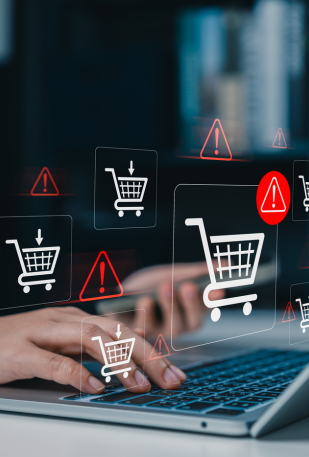
The most obvious one is talking to your potential customers and pretending they’re you. They’ll do that through phishing, where they send emails designed to look like they come from you, or by running ads designed to look like your brand. In both cases, they send your customers to fake storefronts that are carbon copies of your own, all sitting on typosquatted or similar domains that fool the casual viewer. Except instead of buying from you, they’re usually giving their details to criminals who then siphon away their money. Though, occasionally, the criminal seller will actually send them counterfeit goods, made to look like yours, but of much worse quality.
It’s not unique to Cyber Week and the holidays, with WIPO reporting a record number of domain brand disputes in 2025, but it’s something that every brand should be watching out for.
The Cost of Brand Abuse
These bad actors obviously hurt the people who are scammed by them, but their actions are equally damaging to the brands they imitate.
At the lowest level, it’s about the revenue you’re missing out on. Every click that goes to a fake ad is one that is not going to you. A step up from that is the support burden that you take on: because a customer who thought they purchased something from you isn’t going to ask the cybercriminal for updates (though some operate their own fake customer service to steal even more money from victims), they’re going to go to your support staff.
Finally, there’s the brand reputation damage, which is the big one. Because even when people understand that it wasn’t actually you behind the scam, they still won’t trust your brand as much. And the effects of that loss of trust cascade through word of mouth, reduced brand engagement, falling marketing ROI and the loss of future sales.
In short, looking out for your customers is looking out for your brand.
Why Early Detection Matters
The average phishing website stays up for 54 hours, but the median one is only 5.46 hours. Which means that while most imitation websites are taken down incredibly quickly, some can stick around for a few weeks, dragging the average number up. While some website avoid detection by changing their appearance constantly, the more telling difference is in how seriously companies take early detection and constant brand monitoring.
Because catching a phishing site early means you can stop the damage before most of it has been done – before people have had a chance to even notice the emails in their inboxes. But the website that sits, unnoticed, for weeks, while accumulating victims, can cause untold damage to your brand’s reputation.
Spotting them early means you can take them down early. Do it enough, and they might go after easier targets.
What a Brand Threat Assessment Reveals
This is where our Brand Threat Assessment can be a powerful weapon in your defensive arsenal. It gives you a snapshot of domains that are currently registered that match your brand’s name, or similar ones. It’ll let you know when these lookalike domains were registered, through which registrar, and whether there’s currently a website live on them.
You’ll be able to see your own websites, those that use similar domains for innocent reasons, domains that are registered but dormant, and those that are actively being used against you – either now or in the future.
These one-off reports give you a clear view of what is currently out there, giving you the intelligence you need to make the choices required to keep your brand safe. Especially at a time of heightened threats, like during Cyber Week and the end of the year, having that type of clear vision of what you need to be worried about can be vital.
Because having that key intelligence about the threats your brand is exposed to is the first step in keeping it, and your customers, safe.
How to Protect Your Brand This Holiday Season
There are three steps to keeping your brand safe. The first step, as we’ve said, is knowing what’s out there. The second is using threat intelligence to work out what is actually dangerous, and what can be safely ignored for now. Finally, you move to have the active or potential threats taken down.
And then you do it all again. Because even if there is a spike of cybercriminal activity through Black Friday and Cyber Monday, it is part of a larger threat landscape that is the constant backdrop of the internet.
Protecting your brand isn’t something you do once, in an emergency. It’s something you do as a habit or as a strategy. It’s part of how you operate and make decisions.
That’s why, for a limited time, we’re offering customers who purchase a BrandShelter Single Takedown a complimentary Brand Threat Assessment. That way, even as you get the peace of mind from removing one issue, you’ll also get a clear picture of where you stand.
And what better time than now, before the huge rush of legitimate emails and illegitimate phishing ones rain down on your customers, to give your brand an online safety check-up.
Share article




Protect your brand today.
Get in touch today to start your BrandShelter account
Newsletter Subscription
Welcome to BrandShelter
Sign up to our newsletter!
